November 13, 2023
Pedro Garcia on Digital and Sustainable Transformation: "We Are a Small Company That Helps World-Class Companies"

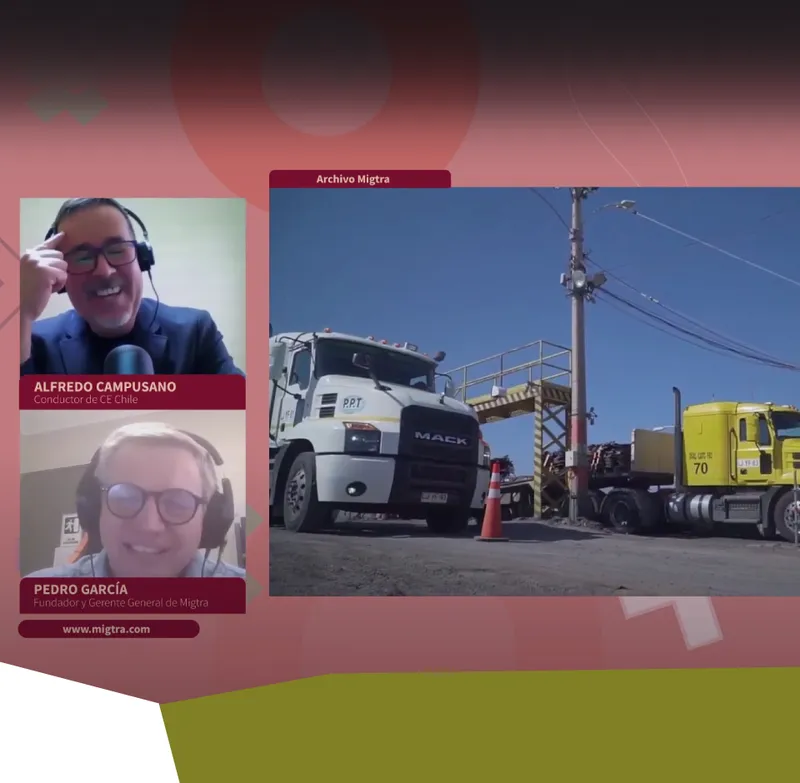
- ✅ An enjoyable and informative conversation between our CEO, Pedro Garcia and Alex Tudor, host at Radio La Clave. Here are some of the most outstanding moments.
Alex Tudor: We are going to talk with a Chilean technology company, which has its artificial intelligence and machine learning solutions, expanding across various countries of the continent, with great clients in Chile like our sponsors SQM and Enex. So we greet Pedro Garcia, CEO and founder of the company MIGTRA, to talk about technology, productivity improvement, accident prevention, transportation systems. Pedro, how are you? Welcome.
Pedro Garcia: Hi Alex, hi Claudio, thanks for the invitation.
Alex Tudor: A pleasure. Pedro will be the co-host of this segment and Claudio Pizarro, CEO of CisConsultores, also adjunct professor of industrial engineering at the University of Chile.
Pedro, tell us a little about MIGTRA, about that name that must be an acronym of something or not an acronym, but born from combining words. When did you start and what do you basically do? There are very interesting topics regarding the technologies you use, but we are also interested in how you improve productivity and prevent accidents in transportation systems, so you have a lot to tell us.
Pedro Garcia: MIGTRA is indeed an acronym for "Intelligent Metrics for Transportation Management." We were born as a way to solve the major problems facing mid-mile transportation systems; those are the ones that go by highway. First-mile ones occur at the sites, the last mile is package delivery, we are helping the transportation systems that carry cargo and people between a plant and a port, between an extraction zone and a plant. We mainly help large mining companies and energy producers. As you mentioned, two of our biggest clients are Enex and SQM. We are a small company, but one that helps very, very large world-class companies. And we help them with this very difficult task of preventing accidents in these transportation systems.
There can be accidents in loading zones, in transit, in unloading zones or at weigh stations, there are control stages. Most accidents in large-scale mining, according to SERNAGEOMIN, occur in the transportation system. That is where there is the most complexity. There are people who are third parties, that is, truck drivers who do not belong to the company, who arrive to pick up or deliver cargo in specific zones and we want those times to be reduced, so as to help the company, our client, make the most of all resources. And this has benefits for the driver, for the fleet provider, for the people working on the loading zone side, on the scale side, etc.
Alex Tudor: Perfect. So basically, it has to do with productivity and preventing accidents in transportation, both cargo and people in this mid-mile.
Claudio Pizarro: Specifically, what is the service?
Pedro Garcia: We take the information that the transportation system already has. We do not sell any type of hardware or anything that needs to be installed; we use the information that exists in the transportation system. We have dispatch guides, access zone information, weighing documents, we have information about drivers behind the wheels of each vehicle, GPS, onboard cameras, security cameras at access zones, at truck covering zones and at weighing zones.
There is a lot of information and we use it to help these transportation systems.
Alex Tudor: An example, with all those cameras, all that dispatch, weighing, well, basically you gather that information and detect possible vulnerabilities, bad habits. Do you recommend changes?
Pedro Garcia: First let's talk about productivity and then about safety, as both topics go hand in hand and then I can explain how they are very closely connected. Let's think about productivity, in a transportation system, if drivers have to wait a long time, they will need more trucks, they will need more drivers, they will have a very large level of inefficiency. If vehicles spend more time within the site, they generate congestion, resource demand and risk. What we do for the benefit of everyone, is that we try to find out where there are problems. We know what is happening every minute in these transportation systems and we can see that there are problems at "scale 4" or problems at "the lithium loading," problems "at the fuel loading for route X." And we use that information within our model to see how it will impact downstream, to notify the place where the cargo will arrive, so they can prepare.
Additionally, most of these systems are circular; meaning, the same truck that is loading now, will deliver the cargo and then return. All the time trucks lose at the point of origin will impact everything on the next round. So, I am also very motivated to solve the problem.
Here we use tools that are very specific, to deliver information to each of these participating entities, to improve productivity: to transporters, to scale managers, to ports. A port that has little space, ideally should know at what time which vehicles will arrive and to deliver what. I can know this several hours in advance. When we travel in our personal cars, Waze gives us fairly good times and tells us what time we will arrive at a destination. But with trucks it is different, because drivers have to rest 8 hours, every 5 hours they have to rest 2 hours, or for every hour of driving at least 24 minutes. Drivers have habits: they stop to eat at certain times and in certain places. Since we have a lot of information and we have artificial intelligence models that identify the behavior of each driver and each truck, routes and loads, on routes that are more than 400 km we can know approximately within six minutes what time a vehicle will arrive.
This allows us to help the port prepare. If right now there are no trucks coming to unload, they have freedom to do other things. Training or breaks can be scheduled. But if we know that starting at seven in the evening there will be a large demand, they can also prepare. They can have more front-end loaders and make the process faster, they can prepare the resources needed for unloading. That is on the productivity side.
We invite you to continue listening to the interview from minute 00:27:38 on Spotify.
Author

Migtra
Marketing