October 5, 2022
CESAR CALDERON: "THE FUTURE OF AI AT MIGTRA"

Cesar Calderon is MIGTRA's Director of Artificial Intelligence and the leader of our AI team (Team Pandas). He holds a degree in Sciences with a mention in Physics and a master's in Astrophysics, has extensive teaching experience at prestigious universities and institutes in Chile, and has focused his knowledge on developing innovative solutions for our clients, using artificial intelligence to achieve excellent results. We talked with him about the past, present and future of AI and MIGTRA in this interview.
Why is MIGTRA's Artificial Intelligence team called Team Pandas?
One of the most widely used libraries in data handling is Pandas, it is quite famous, it is the basic level for analyzing data and we decided that a more educational way to make ourselves known, rather than calling ourselves "the AI team," was to identify ourselves as Team Pandas.
Speaking of Artificial Intelligence, how did this concept originate?
About 10 years ago, around 2010, Artificial Intelligence or AI had a high impact on the world, thanks to the development of the hardware that AI needed to be trained and thus get the most out of it. But the theory dates back 50 years, to the era of World War II. When we had more powerful computers, only then did the rise of AI begin and we were overwhelmed by so much technology.
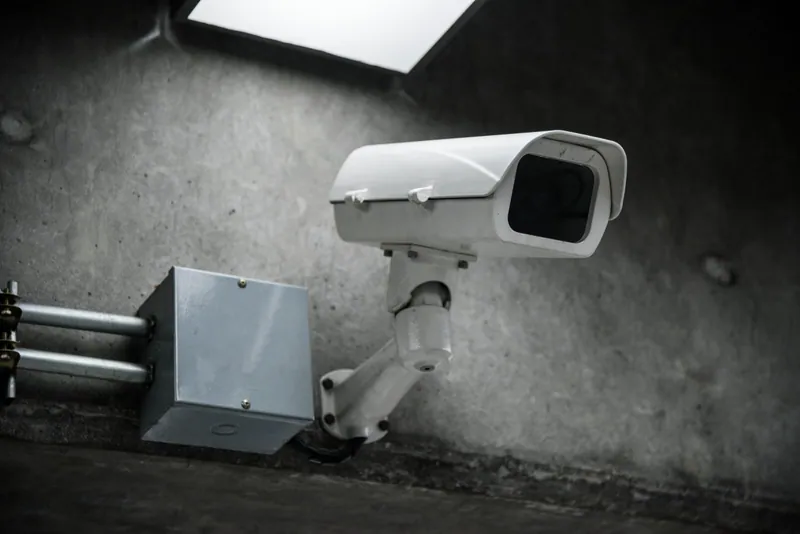
This, hand in hand with the topic of video surveillance cameras, something very common in all small, medium and large-scale companies, generally used to monitor incidents in key parts of the company or in security and theft systems, so you could say that these two areas developed in parallel: AI and video surveillance.
One of the sub-areas of artificial intelligence is computer vision, where through images, algorithms are trained that are capable of identifying what is shown in the image, something that is very easy for us but not for the computer. Computer Vision advanced quite quickly thanks to international competitions held year after year among developers. For example, YOLO was created, a model that trained with a certain dataset can detect a set of 80 different classes of objects, including: people, airplanes, trucks, dogs, etc. There was a set of elements that AI could detect very well and that is when the Data Scientists of companies thought about how to apply this technology to the particular industries of each company.
At what point did MIGTRA introduce AI into its solutions?
What caught our attention was that our clients had many cameras with their CCTV systems and also people dedicated to analyzing these monitors, but we thought it was not viable for humans to be 24/7 monitoring cameras and analyzing different factors. That is when we came up with the idea of using AI to monitor the cameras that the industry has and focus it on our purpose which is the safety of the transportation chain.
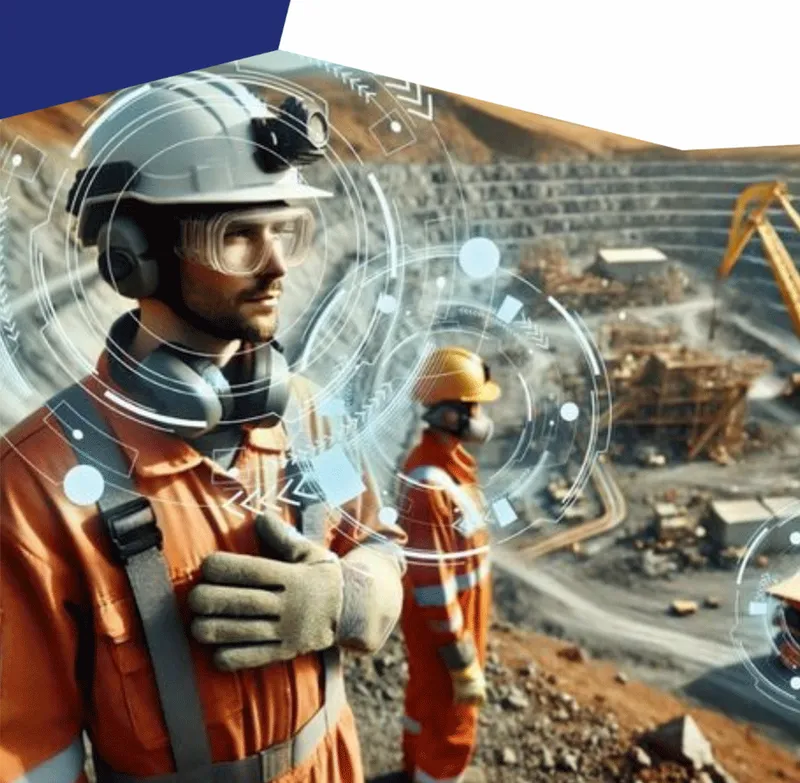
Level 1 where we incorporated AI was PPE detection or personal protective equipment and we started there, replacing the manual task of monitoring cameras and detecting with AI algorithms the correct use of helmets, gloves and other protective elements.
The first client with whom we tested this technology was SQM in their work at heights: since their trucks carry products that can blow away on the highway (because they are bulk), by decree they cover the truck and must do so at 2 meters height, which is risky. The driver climbs onto a platform and must have PPE and a lifeline to hold them in case of an accident, so they do not fall and remain suspended in the air.
That was our first challenge and we called it MIGTRA Video Analytics. This algorithm has been running for 3 years and is in constant evolution. That speaks very well of our expertise and is an example of how technology advancement allows us to improve algorithms.
How has MIGTRA Video Analytics evolved?
In its reaction capacity. At the beginning, the solution only worked after the fact (often the next day) so it was not that effective, it served for management but not to prevent accidents. Today, it works through real-time alerts and that changed the solution's paradigm. When it detects that the worker does not put on the PPE, there is a speaker that alerts them. That is why we say it is no longer just after the fact but also reactive and preventive, that is how the algorithm has evolved.
What other features does MIGTRA Video Analytics have besides detecting personal protective equipment?
We have different services in the same area of computer vision. One of the things that characterizes us is that we create custom services. For example, within Video Analytics we have dynamic prohibited zone detection.
Imagine a train going on a rail, the prohibited zone is not always static, it changes as the train approaches the person. That is what this tool detects. It also has the ability to count objects. In one of the cases we worked on, there are metallic tubes going down from a certain platform owned by our client and thanks to AI we can carry out counting effectively.
We also analyze the quality of certain products through color. For example, in the case of fertilizer, when the quality of chemicals changes, the color changes and when the client exports that type of product, they realize it is not the product they expected to buy, so early detection of these deviations is important.
Were all these actions previously done by people?
Yes, all the services we have developed are to relieve the workload of the people who watched the cameras and with that we free the person who watched cameras to focus on areas where they have more expertise, like being in the field.
We have to think that when you are looking at different cameras, human peripheral vision in real time is very limited. MIGTRA's idea is to maximize people's potential, so that our clients use risk prevention officers in managing this type of information and not monotonously monitoring cameras. There is a myth that AI comes to replace human work, when in reality it is another tool for prevention officers (in the case of PPE detection) or those responsible for the operation (in the case of prohibited zone detection and quality control). The use of AI is transversal to all monitoring areas.
Is AI used in other areas of MIGTRA?
Yes, we have a service called ETA, which uses machine learning, where we take data and can predict the arrival time of trucks at a site. This service was generated mainly by the need that decision-makers have: when they receive vehicles at the mining site, they direct them to load at their respective areas, but bottlenecks are generated when many trucks enter at the same time and drivers must wait a long time.
To prevent them from being in line and reduce these inconveniences, it is necessary to have a system that tells you how many trucks arrive in real time and thus reduce waiting times. Waiting times before were 2 to 3 hours and now they are 15 minutes, all thanks to the ETA service.
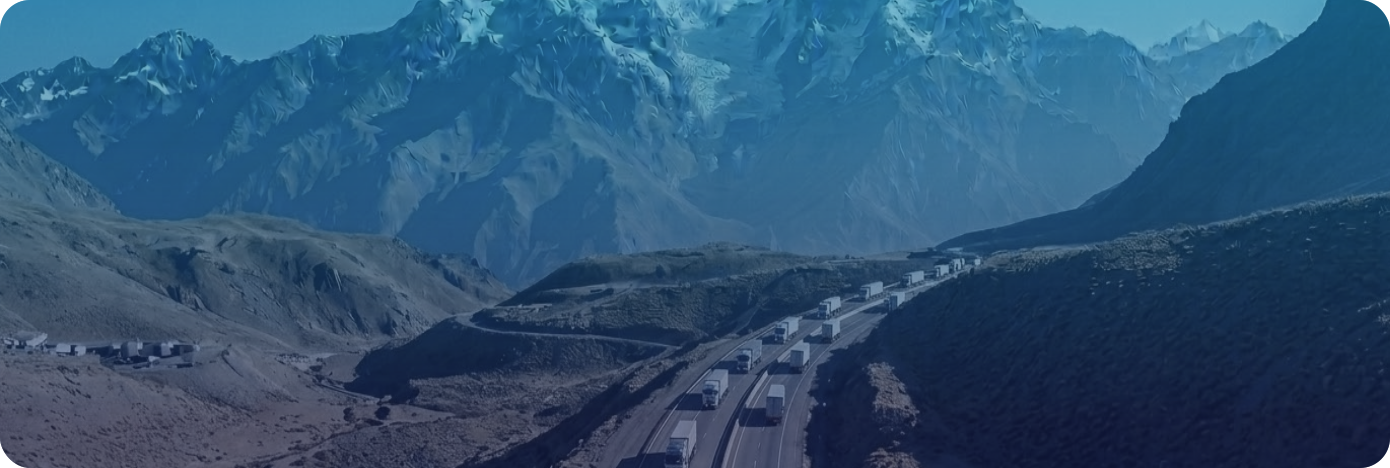
Route 5 north, where these trucks travel, is quite clear, but drivers drive 16 hours a day and every few hours they must rest and take recovery breaks, which include going to the bathroom, eating and sleeping. Those short and long stops we include in the algorithm, to predict how long the driver will be stopped for those contingencies. Before, that did not exist, decision-makers relied on the GPS map and manually estimated how long the trucks could take, but they did not consider the stops. Additionally, due to the volume of vehicles, because there are 300, 400 vehicles in total, the ETA service is of great help to decision-makers in their daily work.
We have developed these ideas with SQM. They request the service and since we have been strategic partners for years, we have the trust to propose solutions to them. With artificial intelligence sometimes there is uncertainty about whether the solutions will be achieved with the expected accuracy, it is a process of innovating and experimenting.
When Team Pandas starts developing an idea, how long does it take to achieve the final product?
In the case of ETA it took us 6 months to implement it the first time, but when a new client comes now it takes us less (approximately 2 months). This is due to know-how, we already know which models work best for each client. What takes us the longest is collecting data.
In addition to ETA, we have within AI the area of natural language processing and within that area we developed the virtual assistant ArmonIA, called "the Siri of Mining."
ArmonIA was born from the need of SQM workers to have information at hand and at any time. What happened was that with ETA we had solved a large part of the problem to reduce bottlenecks, but we did not count on the fact that decision-makers spend a large part of their time in the field (80% of their work hours), moments when they did not have access to the platform on a computer and had to call the booth for someone else to log in and provide them with information by phone.
One way to cover 100% of their work hours was to develop a virtual assistant on their phone, which they could ask how many trucks will arrive in the next hour and other topics of interest. The ArmonIA app enters the database, checks ETA and delivers the most reliable information in seconds. Among MIGTRA's solutions, ArmonIA had to be a voice assistant for two reasons: because users are driving and cannot be distracted, and because all our clients are in the north and the sun makes it difficult to see phone screens, so we came up with the idea that the best solution was a voice assistant.
There we added an additional value. We wanted it to be as simple to use as possible and to break down the language barrier between the user and the virtual assistant, incorporating mining vocabulary and terms that are specific to that industry. ArmonIA can understand mining jargon when the user speaks to it.
What projections do you have for ArmonIA and other MIGTRA solutions in the future?
ArmonIA marks the before and after of MIGTRA, because infinite doors open, not only with ETA and Computer Vision services, but the idea is that ArmonIA is everywhere and integrates our other solutions like RAEV (accident risk from speeding), Carbon Footprint, etc.
We want every decision-maker to have their dashboard at hand on their phone and also that it is not only MIGTRA solutions, but that other companies can connect to the ArmonIA app if they wish.
This does not replace the role of computer dashboards and the reports of each solution, which allow analyzing deviations in greater detail, but ArmonIA will deliver the most important data quickly and in a more simplified way. We consider that each person's time is the most valuable thing and who better than ArmonIA to overcome this difficulty of looking at the dashboard for a long time.
When will we be able to see the new features of this app?
The new features of ArmonIA will be ready in a couple of months and on the other hand, we want ArmonIA to be preventive, meaning not only that you query the application, but that it tells you there is an anomaly and warns you when truck demand increases. That way, the app will be supporting you at all times, like a conscience by your side. We project all of that for the next semester of 2023.
Who can use ArmonIA?
The app is a free service and is available on Play Store, but you need a user, which must be contracted with us. I recommend it for users of all industries, we want to reach transportation and safety in all types of companies. For example, our clients could integrate ArmonIA with the other MIGTRA solutions they already have contracted. We want to reach different sectors, not only mining, and thus expand our services.
What other plans does MIGTRA have?
We have an ace up our sleeve: an AI decision-maker, which will allow that when a truck arrives at any site, it can be attended to on its own. For this, we are going to develop an algorithm that is capable of understanding what is happening and giving instructions to the driver. It is necessary to understand which products need to be removed, the occupancy of the loading areas and other matters, to have a complete understanding of the operation, in order to develop this algorithm well. This idea arose two years ago, but we needed more knowledge like ETA and the productivity dashboards, which will help us couple everything and have knowledge of the entire operation.
We are working at the Salar de Atacama with SQM to create this virtual decision-maker that will understand the different logics and ideally improve all decisions to optimize stop time goals and the quantity of products transported.
This is not meant to take the job away from real decision-makers, but will be a help and extension of their work since it will suggest the plan to carry out and thus use their talents in other functions that add more value to the company. This project is within an area of Artificial Intelligence called reinforcement learning and we are very interested in covering it, one of the last areas we were missing from the entire range and we are very happy that it achieves the expected impact. It is a great project and the extension is to all companies that need to assign loads or products to trucks that are entering.
Is Artificial Intelligence present in other solutions like the new MIGTRA RA?
In the case of RA, artificial intelligence is not implemented, but it is within the plans to integrate AI to optimize decision parameters. Today, through a fairly simple ranking we use RAEV, but there are many interesting parameters that could be analyzed to make a much more conscious ranking of all the factors. There we believe that AI could be managing and communicating a more ad hoc ranking, with more parameters that enrich it to make more informed decisions.
You mentioned that there is a fear that AI will replace human work. What other myths are there around artificial intelligence?
Among the myths, there is the topic of data. There are different areas of AI and some require more data than others. There is a myth that infinite data is required and it is not necessarily so. Chile as a country has an ideology around AI and is working on digital transformation. The history we have with the companies we work with is sufficient to work with AI and generate algorithms for specific and focused tasks. With that type of information you can simplify problems quite a bit.
In that sense, a myth is Big Data. A large volume of data is not necessary for every project. Clearly more data is better, but gigabytes of data are not necessary to start impactful projects in terms of productivity and safety.
Why should companies hire MIGTRA's AI services?
It is important to understand that AI projects generally require 3 areas: data engineering (which extracts information from the client), the data science area (which creates AI models) and visualization which makes dashboards available. At both extremes there is quite a bit of demand and labor supply, but in the data science area it is hard to find good data scientists. That is why it is quite costly to create this area within a company and it is easier to outsource this service to MIGTRA, because we have the different areas, the experience and the appropriate knowledge, something that would take a lot of time and money for companies to create themselves.
Author

Migtra
Marketing